

Getting dressed should not feel like solving a puzzle every morning. If you have a closet full of shirts, trousers, jackets, and shoes but still stop to ask if the colors work together, you are not alone. A few simple rules can take much of the guesswork out of dressing well.
This guide shows you how to color-coordinate outfits after 50 using colors that are easy to mix and wear.
You do not need a closet full of bright colors or expensive clothes. A few good neutrals, some simple color pairings, and the right shoes can give you plenty of outfit choices.
The goal is to make your clothes work together without spending ten minutes in front of the mirror.
You will learn when to use navy, gray, beige, brown, white, blue, and other easy colors. You will also see how small details such as your belt and shoes can pull an outfit together.
Most of these ideas take less than a minute to check once you get used to them.
What You Need
At a Glance
- Start with two main colors
- Build outfits around neutral colors
- Match your belt with your shoes
- Use one strong color as an accent
- Pair light tops with darker bottoms
- Keep similar colors in the same outfit
- Choose colors that work with your skin tone
- Check the whole outfit before leaving
Start with Two Main Colors

Pick two main colors before adding anything else. For example, try navy trousers with a light blue shirt, or beige trousers with a white polo. This gives the outfit a clear base without making you think about every small detail.
If you want a third color, use it in a small amount. Brown shoes with navy and white work well because the brown stays in the background. Keeping the main outfit to two or three colors makes daily dressing much faster.
Build Outfits Around Neutral Colors

Neutral colors give you more choices. Navy, gray, beige, white, cream, brown, and charcoal can work with many other colors. Start with one neutral item and build from there.
A navy pair of trousers can work with white, light blue, pink, olive, or gray. Beige trousers can work with navy, white, dark green, and brown.
If your closet has several neutral pieces, you can create many outfits without buying lots of new clothes.
Match Your Belt With Your Shoes

Your belt and shoes do not need to be the exact same shade, but they should look like they belong together. Brown shoes pair well with a brown or medium-brown belt, while black shoes look cleaner with a black belt.
This small detail can make an outfit look more put together without adding another color. If you wear loafers or dress shoes in a lighter brown, choose a belt in a similar brown family instead of trying to find the exact shade.
Use One Strong Color as an Accent
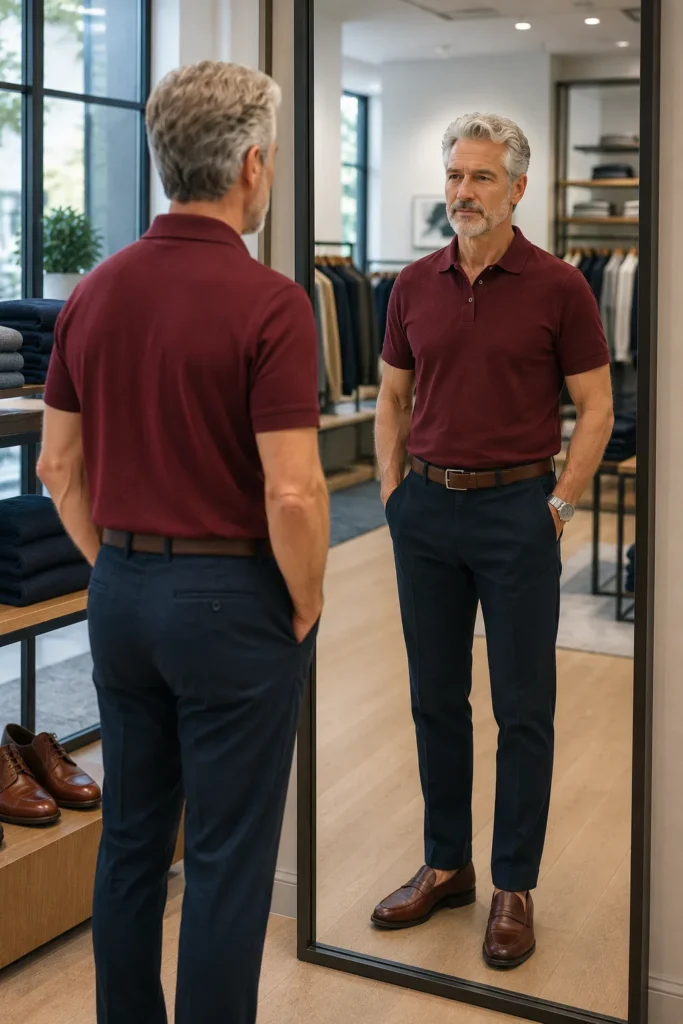
A bright color can make a simple outfit feel more interesting, but you do not need several bold pieces at once. Choose one item to carry the stronger color.
Try a burgundy polo with navy trousers, a forest-green sweater with beige chinos, or a muted rust shirt with dark blue jeans. Keep the rest of the outfit quiet so the accent color has room to stand out.
If a shirt feels too bright for your usual style, wear it under a neutral jacket. The jacket softens the color while still giving the outfit some interest.
Pair Light Tops With Darker Bottoms

A light shirt with darker trousers is one of the easiest combinations to wear. White, cream, light blue, and pale gray tops work well with navy, charcoal, dark brown, or dark denim.
The contrast also helps each piece look clear instead of blending together. For a relaxed outfit, try a light blue polo with dark navy trousers and brown loafers. For a more casual look, use a white T-shirt, dark jeans, and clean brown sneakers.
Keep Similar Colors in the Same Outfit

Colors from the same family can work together without looking boring. This is useful when you want a calm outfit and do not want to spend much time deciding what matches.
Try a light blue shirt with navy trousers. You could also wear a cream polo with beige chinos and brown shoes. The shades are different enough to give the outfit shape, but they still feel connected.
Avoid wearing several pieces in nearly the same dark shade with no contrast. Navy trousers and a navy shirt can look flat if the shades are too close. Add a lighter layer or a different texture to break things up.
Choose Colors That Work With Your Skin Tone

Hold a shirt near your face in natural light before deciding if the color suits you. Some colors can make your face look fresh, while others may make you look tired or washed out.
You do not need strict color rules. If navy, soft blue, olive, burgundy, or cream looks good on you, keep using those shades. If a very bright yellow or pale gray makes your skin look dull, move it away from your face and use it in trousers or accessories instead.
Check the Whole Outfit Before Leaving

Look at the full outfit in a mirror before you head out. Check the shirt, trousers, jacket, belt, and shoes as one group rather than judging each piece by itself.
A quick check can catch small problems, such as a black belt with brown shoes or too many strong colors in one outfit. If something feels off, remove one item before adding another. Often, a simpler outfit looks better than one with more color.
Before and After Expectations
Before
You spend time wondering which shirt, trousers, belt, and shoes match.
After
You can build a balanced outfit from a few familiar colors in a few minutes.
Troubleshooting Table
| If This Happens | Try This |
|---|---|
| The outfit has too many colors | Remove the brightest piece and keep two main colors. |
| The outfit looks too dark | Add a white, cream, or light blue shirt. |
| The shoes feel out of place | Check that the belt and shoes belong to the same color family. |
| The colors look too flat | Add contrast with a lighter shirt or darker trousers. |
Quick Reference
8 Color Rules to Keep Handy
- Start with two main colors.
- Use navy, gray, beige, white, and brown as your base.
- Keep your belt and shoes in the same color family.
- Use one strong color as an accent.
- Pair light tops with darker bottoms.
- Try different shades from the same color family.
- Wear colors that make your face look fresh.
- Check the complete outfit before leaving.
Finish With a Simple Color Check
You do not need to match every piece perfectly to dress well after 50. Start with two main colors, add neutrals, and use one stronger color when you want more interest.
Check your belt and shoes, look at the outfit as a whole, and remove anything that feels too loud.
Once these rules become familiar, color-coordinating outfits after 50 becomes much easier.
Save this guide on Pinterest so you can check these color ideas the next time you get dressed.